
The history of hologram security stickers is a fascinating journey that combines cutting - edge technology with the constant need for security in various industries. As a supplier of hologram security stickers, I've witnessed firsthand how these ingenious creations have evolved over time to safeguard products, documents, and information.
Early Beginnings: The Invention of Holography
The story of hologram security stickers starts with the invention of holography itself. In 1947, Hungarian - British physicist Dennis Gabor developed the theory of holography, for which he later received the Nobel Prize in Physics in 1971. Gabor was working on improving electron microscope resolution at the time. His key insight was to record both the amplitude and phase of light waves scattered by an object, rather than just the intensity as in traditional photography. This created a three - dimensional (3D) record of the light field, which could be used to reconstruct a virtual image that appeared as if the object was still present. However, the lack of a suitable light source limited the practical applications of holography in the early days.
The Emergence of Laser and Practical Holograms
The development of the laser in 1960 was a game - changer for holography. Lasers provided the coherent light necessary to create high - quality holograms. In 1962, Yuri Denisyuk in the Soviet Union and Emmett Leith and Juris Upatnieks in the United States independently discovered how to create holograms using lasers. This led to a rapid expansion of holographic research and its applications.
Initially, holograms were mainly used for artistic and scientific purposes. They were displayed in museums and art galleries, wowing audiences with their realistic 3D images. Scientists also used holograms for studies in fluid dynamics, stress analysis, and non - destructive testing.
Holograms in Security Applications
The security industry soon recognized the potential of holograms. The unique optical properties of holograms, such as their 3D appearance, iridescence, and the complexity of their diffraction patterns, made them extremely difficult to counterfeit. In the 1980s, holograms started to be used on credit cards as a security feature. MasterCard was one of the first major financial institutions to adopt holograms on its cards in 1983. The holographic images on credit cards were not only visually striking but also served as a reliable way to distinguish genuine cards from counterfeits.
Around the same time, holograms began to appear on other high - value items, such as luxury goods, pharmaceuticals, and official documents. For luxury brands, hologram security stickers were an effective way to prevent the production and sale of counterfeit products. Counterfeit luxury goods not only cause financial losses to the brands but also damage their reputation. Holograms on packaging and products gave consumers a quick and easy way to verify the authenticity of the items they were purchasing.
Technological Advancements in Hologram Security Stickers
As technology advanced, so did hologram security stickers. The early holograms were relatively simple, with basic 3D images or patterns. Over time, more sophisticated techniques were developed to create holograms with enhanced security features.
One such advancement was the introduction of hidden images and microtext. These elements are not visible to the naked eye under normal viewing conditions but can be revealed using special optical devices or lighting angles. Hidden images and microtext add an extra layer of security, as counterfeiters would have a hard time replicating these features accurately.
Another significant development is the integration of barcodes and QR codes into hologram security stickers. For example, our Silver Holographic QR Code Security Sticker Labels combine the visual appeal and security of holography with the data - storing capabilities of QR codes. The QR codes can be scanned to access product information, verify authenticity, and track the product's supply chain.
3D and Transparent Holograms
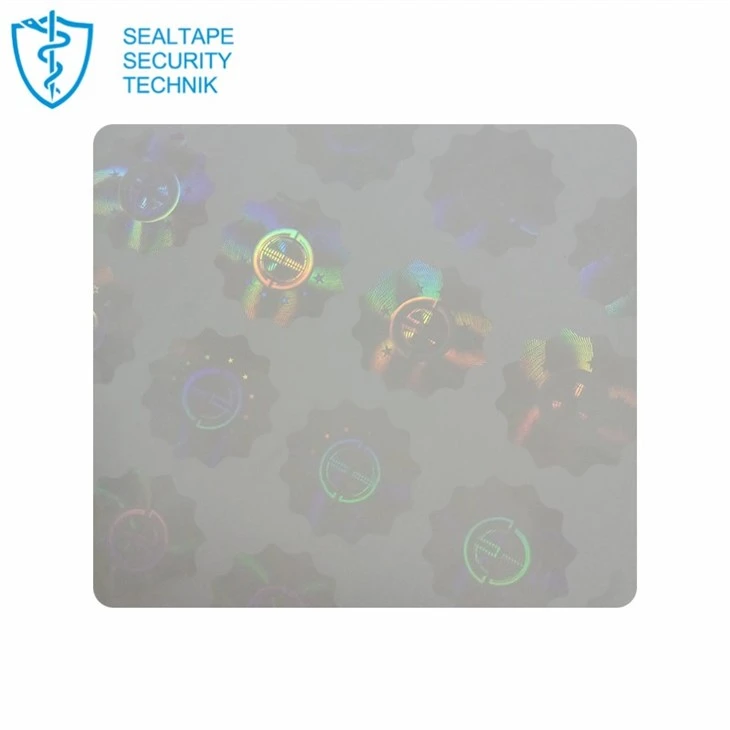
The demand for more advanced and visually appealing hologram security stickers has led to the development of 3D and transparent holograms. Our Transparent 3D Laser Hologram Security Sticker offers a unique combination of transparency and 3D effects. These stickers are not only useful for security purposes but also provide an eye - catching way to enhance the appearance of the products they are applied to.
The 3D gold barcode VOID hologram security sticker labels, like our 3D Gold Barcode VOID Hologram Security Sticker Label, are another example of the latest technological achievements in this field. The VOID feature means that if someone tries to remove the sticker, it will tear and leave behind a visible "VOID" message, indicating tampering.
Current and Future Trends
In today's digital age, hologram security stickers continue to play a crucial role in anti - counterfeiting efforts. With the rise of e - commerce and the global supply chain, the need for reliable product authentication has become even more pressing.
Looking to the future, we can expect to see further integration of holography with other emerging technologies, such as blockchain and artificial intelligence. Blockchain can be used to create an immutable record of a product's authenticity and history, while AI can be employed to detect counterfeit holograms more accurately.
Why Choose Our Hologram Security Stickers?
As a supplier of hologram security stickers, we are committed to providing high - quality, innovative, and cost - effective solutions. Our stickers are produced using state - of - the - art technology and undergo rigorous quality control to ensure their security and durability.
Whether you are in the finance, luxury goods, pharmaceutical, or any other industry that requires product authentication, our range of hologram security stickers can meet your specific needs. We understand that each client has unique requirements, and we work closely with them to develop customized solutions.
Contact Us for Procurement and洽谈
If you are interested in learning more about our hologram security stickers or would like to discuss procurement options, we would be delighted to hear from you. Contact us today to start a conversation about how we can help safeguard your products and brand.

References
- Gabor, D. (1948). A new microscopic principle. Nature, 161(4098), 777 - 778.
- Leith, E. N., & Upatnieks, J. (1962). Reconstructed wavefronts and communication theory. Journal of the Optical Society of America, 52(10), 1123 - 1130.
- Denisyuk, Yu. N. (1962). Photography of optical wave fields. Soviet Physics Doklady, 7, 543 - 545.